📋 Adaptive Assessment Log
> A score log for externally-administered standardized assessments. Synalux stores, charts, and trends scores that you collected and scored on the publisher's official platform. It is not an assessment instrument — it does not administer, score, or reproduce any standardized test.
What This Module Is — And Is Not
This module IS:You administer and score the assessment on the publisher's platform under the qualification rules they require. You then type the resulting standard scores into Synalux so the clinical record is complete in one place.
Strict Naming & Content Policy
The Adaptive Assessment Log is instrument-agnostic by design. The following rules apply to every UI label, database column, code identifier, marketing page, comparison table, and AI-assistant prompt:
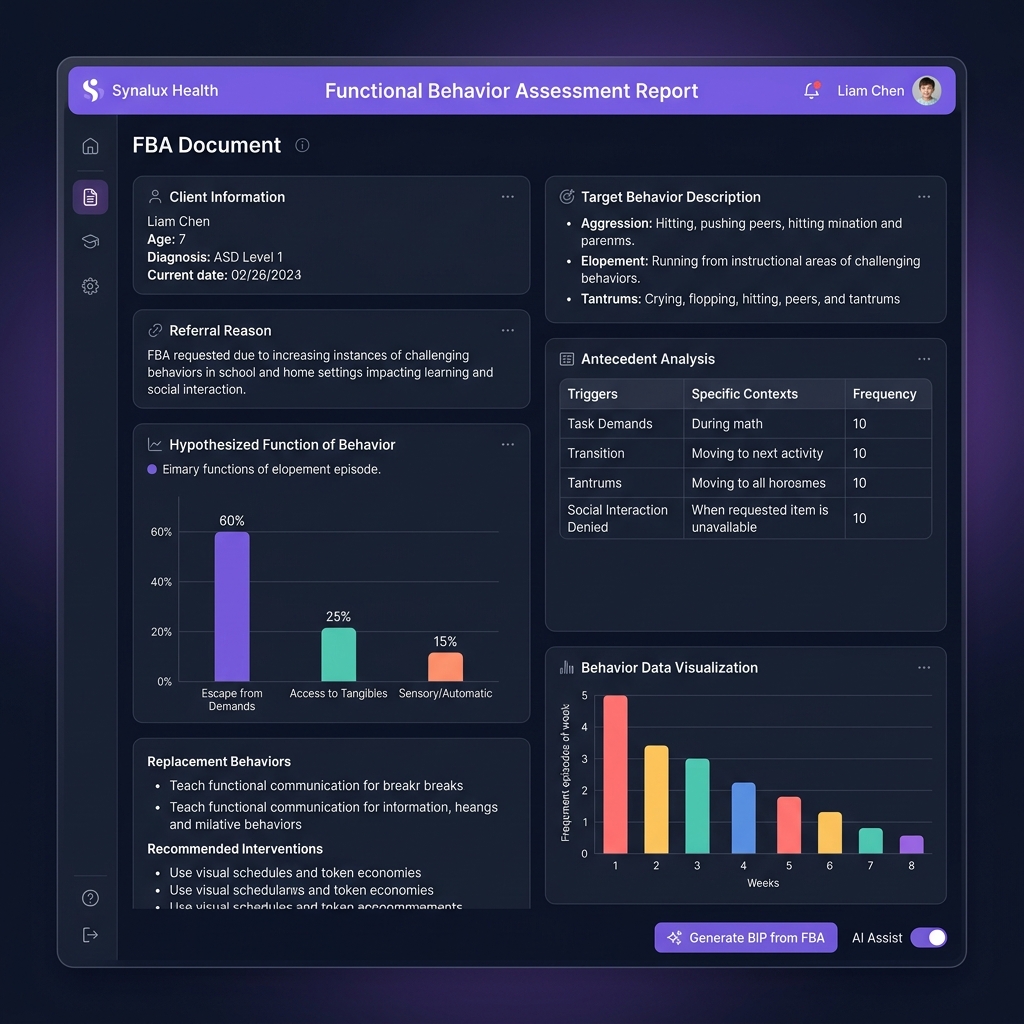
✅ Allowed
❌ Forbidden
The forbidden list is enforced by the BCBA AI Assistant skill and by a CI check that greps documentation for the forbidden patterns outside of compare-table delimiters.
Supported Instruments (Score Storage Only)
The module accepts standard scores from any norm-referenced or criterion-referenced assessment the clinician chooses. Instruments below are named only for the clinician's reference when they enter a record. Synalux does not include item content, scoring algorithms, or normative data for any of them.
| Domain | Examples of instruments scores can be stored for |
|---|---|
| Adaptive functioning | Vineland-3, ABAS-3 |
| Verbal behavior / skill acquisition | VB-MAPP, ABLLS-R, AFLS, Essential for Living |
| Cognitive / developmental | Bayley-4, Mullen, DAS-II, WPPSI, WISC, Stanford-Binet |
| Language | CELF, PLS, REEL |
| Behavior rating | BASC-3, CBCL, Conners-3 |
| Autism-specific | ADOS-2, ADI-R, GARS-3, CARS-2 |
| Sensory | SP-2 |
> Trademark notices. Vineland-3® is a registered trademark of NCS Pearson, Inc. ABAS-3® is a registered trademark of Western Psychological Services. VB-MAPP® and ABLLS-R® are registered trademarks of their respective publishers. AFLS® is a trademark of Partington Behavior Analysts. Essential for Living® is a registered trademark of Patrick McGreevy. ADOS-2® and ADI-R® are registered trademarks of Western Psychological Services. BASC-3® is a registered trademark of NCS Pearson, Inc. All other instrument names are trademarks of their respective owners. Synalux is not affiliated with, endorsed by, or sponsored by any of these publishers. Use of these names is nominative: it identifies the instrument the clinician administered externally so they can label the score record correctly.
Data Model — What Gets Stored
Each record is a typed-in summary of an assessment the clinician completed elsewhere. The module does not store derived items, response patterns, or any content the publisher considers part of the test. The shape uses textbook psychometric vocabulary (composite, domain, subdomain, standard score, confidence interval, v-scale / scaled score, age equivalent, percentile rank, pairwise difference) — these are generic statistical concepts that appear across virtually every adaptive / cognitive / language battery, not specifics of any one instrument.
Top-level record
| Field | Type | Notes |
|---|---|---|
| Client | FK | Links record to client chart |
| Instrument | string (free text) | Clinician types the instrument label they administered |
| Form / version | string | E.g., "3" / "Comprehensive" / "Parent/Caregiver Form" |
| Administered on | date | Date of administration |
| Administered by | string (free text) | Examiner name (often the workspace clinician, sometimes external) |
| Respondent name | string (free text) | When the form is informant-based (parent, caregiver, teacher, support staff) |
| Respondent relationship | string (free text) | E.g., "parent", "personal support staff" |
| Administration language | string | ISO-639-1 |
| Source PDF | file attachment | Optional — raw report from publisher's platform |
| Narrative | rich text | Clinician's own prose summary |
| Created / updated | timestamps | Standard audit trail |
Score block — generic shape
The score data is a free-form JSONB blob the clinician populates with standard-score rows. The recommended shape mirrors how psychometric reports are typically laid out — a composite at the top, domains beneath it, optional subdomains beneath each domain, and pairwise difference rows linking any two of the above. None of these fields are instrument-specific.
``jsonc
{
"composite": {
"label": "
"standard_score": 0, // numeric
"ci_95_low": 0, "ci_95_high": 0,
"percentile": "<1" // string — supports "<1" / ">99" / "50"
},
"domains": [
{
"label": "
"standard_score": 0,
"ci_95_low": 0, "ci_95_high": 0,
"percentile": "<1",
"ss_minus_mean": 0, // numeric — clinician copies from report
"strength_or_weakness": null, // "strength" | "weakness" | null
"base_rate": "<=25%" // string label
}
],
"subdomains": [
{
"domain_label": "
"label": "
"raw_score": 0,
"scaled_score": 0, // generic name — covers v-scale, scaled, T, etc.
"age_equivalent": "2:6", // string, year:month — supports "<3:0", ">21:0"
"growth_value": 0, // optional — some instruments report this
"percent_estimated": 0, // optional — used when items are skipped/extrapolated
"scaled_minus_mean": 0,
"strength_or_weakness": null,
"base_rate": "<=10%"
}
],
"pairwise_diffs": [
{
"left_label": "
"right_label": "
"left_value": 0, "right_value": 0,
"diff": 0,
"significant": true, // boolean
"base_rate": "<=15%"
}
],
"out_of_age_range": ["
"significance_level": 0.10
}
`
Why JSONB, not a normalized score table
Two reasons:
, expressive, written for Vineland-3) would encode that instrument's specific construct hierarchy in our schema, which crosses the line from "storing what the clinician typed" into "modeling the instrument's structure". JSONB with clinician-typed labels keeps Synalux on the right side of that line.Charts, exports, and AI-assistant pulls iterate over domains[] and subdomains[] generically, reading whatever labels the clinician typed.
How the BCBA AI Assistant Uses Adaptive Assessment Log Records
When the clinician asks the assistant to draft a medical-necessity letter, BIP rationale, or DDA narrative, the assistant can:
The assistant must not:
Workflow
Screenshots
> The form schema is workspace-admin-editable via /admin/form-builder (see Synalux Dev Rule 6 in synalux-private/DEV_RULES.md), so the screenshot below shows the seed default — your tenant may look different after admin customization.
New record (seed default — top-level metadata + composite scores)
Screenshot pending — re-run portal/tests/ui/adaptive-assessment-log-screenshot.spec.ts to generate.
Pending capture (when those UI surfaces ship)
| Screen | Status |
|---|---|
| Record list / trend chart in the client chart | TBD — trend view not yet built |
| Practice admin editing the form via /admin/form-builder | TBD — form-builder edit flow needs to load existing form_configs first |
| Source-PDF attachment view (audit-logged on every open) | TBD — viewer flow not yet built |
UI behavior is pinned by the test at portal/src/__tests__/adaptive-assessment-log-form.test.tsx — 5 cases covering the seed-default field set, free-tier filtering of the standard-tier subdomain JSON field, the audit-logged Source-PDF control, and required-field validation on submit.
Audit & Compliance
Source PDF Attachments — Sensitive Handling
The optional Source PDF attachment field is the highest-sensitivity artifact this module touches: it's the unredacted report exported from the publisher's platform (e.g., Vineland-3-Comprehensive-Report_ from Pearson Q-global). These reports contain client name, DOB, age, full subdomain item-level breakdowns, and scoring narratives.
Required handling for every Source PDF attachment:
and the platform's training-data pipelines treat that tag as a hard exclusion.Roadmap
---
🔗 Related: BCBA AI Assistant skill · Applied Behavior Analysis (ABA) Module · Audit & Compliance Architecture
Video Walkthrough
width="100%" height="400" src={"https://www.youtube.com/embed/m94a2a7qREQ"} title="Forms & Assessments Walkthrough" frameBorder="0" allow="accelerometer; autoplay; clipboard-write; encrypted-media; gyroscope; picture-in-picture" allowFullScreen />